Streams of India and Blues Essence
(World Music Central - North Carolina, USA.)
BY AROMERO
– FEBRUARY 5, 2012POSTED IN: CD REVIEWS
MoonArra
Indian Accent ( WMC21, 2010)
Indian Accent is the debut album by Bangalore-based world fusion band MoonArra. The musicians make a fascinating mix of Indian music, jazz and blues. Their sound is characterized by engaging vocals that include three styles: poetic English language vocals with jazz and blues inflections, Hindustani vocals and konakkol (vocal percussion).
On the instrumental side, MoonArra presents superb musicianship, where the slide guitar morphs from blues style to Hindustani style and interacts with other guitars and oud. The finely-calibrated rhythm section features drum kit and Indian percussion, and electric bass.
Indian Accent is an impressive debut album by one of the emerging talents in the Indian world fusion scene... .
"Just to formally congratulate you on an even better second version of the Jazz fest, and thank you for giving us a premium view of it! Also to mention again that the Moonarra band was just exceptional and I will take you up on your offer of sharing their music CD with me. Cheers and best wishes for more such wonderful events! "
Pittu/Alwyn Didar Singh, New Delhi--Former Secretary to the Govt. of India ( guestbook comment on http://sehernow.in)
... The next band was Moonarra from Bengaluru, comprising of Jagadeesh M.R (Guitars, Oud, composer), Madhuri (singer/songwriter), Prakash Sontakke (slide guitar, Hindustani vocals), Karthik Mani (Percussionist/ Drummer) and Wilson Kenneth (Electric bass). Their music was a rich fusion of jazz, Carnatic and Indian classical music, which was a never-heard-before experimental music which they have developed into smooth flowing sound over the years. Prakash Sontakke, who has a rich Hindustani music background, played out melodies from his Hindustani hawain slide guitar that wove into a fine tapestry of sound. Their rendition of the 'Vande Mataram' was totally out of the world! - Jazz just got bigger in Delhi!
New Delhi, March 18, 2012
Truly Trancendental Music, the Moon Arra ensemble was in full flow at the second of the Jewel in the Lotus concert series held yesterday ( Mar 14, 2015)at the Indranagar Rangasthala in Bengaluru Santhe. In an interactive session with the audience before the concert, they spoke about their unusual instruments like the Oud, the Dobro, the Cajon and the styles of music they drew their influences from - Jazz and Hindustani. The show which commenced with an Ellington standard with an amazing Indian twist took the listeners through a fascinating journey through unchartered territories. Original compositions which started in a rhythm of 5 melted in the chorus into a 6 and then back without the audience suspecting it in the least. The highlight for me though, was the wistful Michael Jackson song - "gone to soon" surreally sung by Madhuri, backed with eclectic sounds from the slide guitar of Prakash Sontakke and the jazz harmonies of Jagadish's line 6 custom acoustic gat, literally leaving the audience transported. The multi flavoured concert ended with a gypsy like collusion between the gorgeous voices of Chaitra Sontakke and Madhuri. - Gopal K Navale
A magical night on a rooftop in Bangalore with amazing musicians from three continents, Europe, Asia, Africa - contemporary genre bending music with deep roots - Biggi Vinkeloe
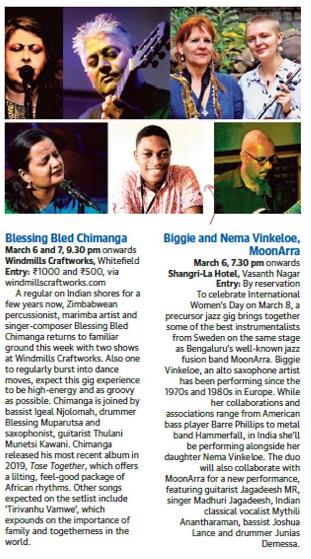
From a live concert recording at Blue Frog, Bengaluru on Dec 2 - 2018. (Engg: Amrit Raghunathan)Please listen with headphones on.
Eternal Spring-edit.mp3
Silk Roots-edit.mp3
Upstream-edit.mp3
Free Spirit-edit.mp3
ATTENTION THIS IS NOT CENSORED! An experimental project involving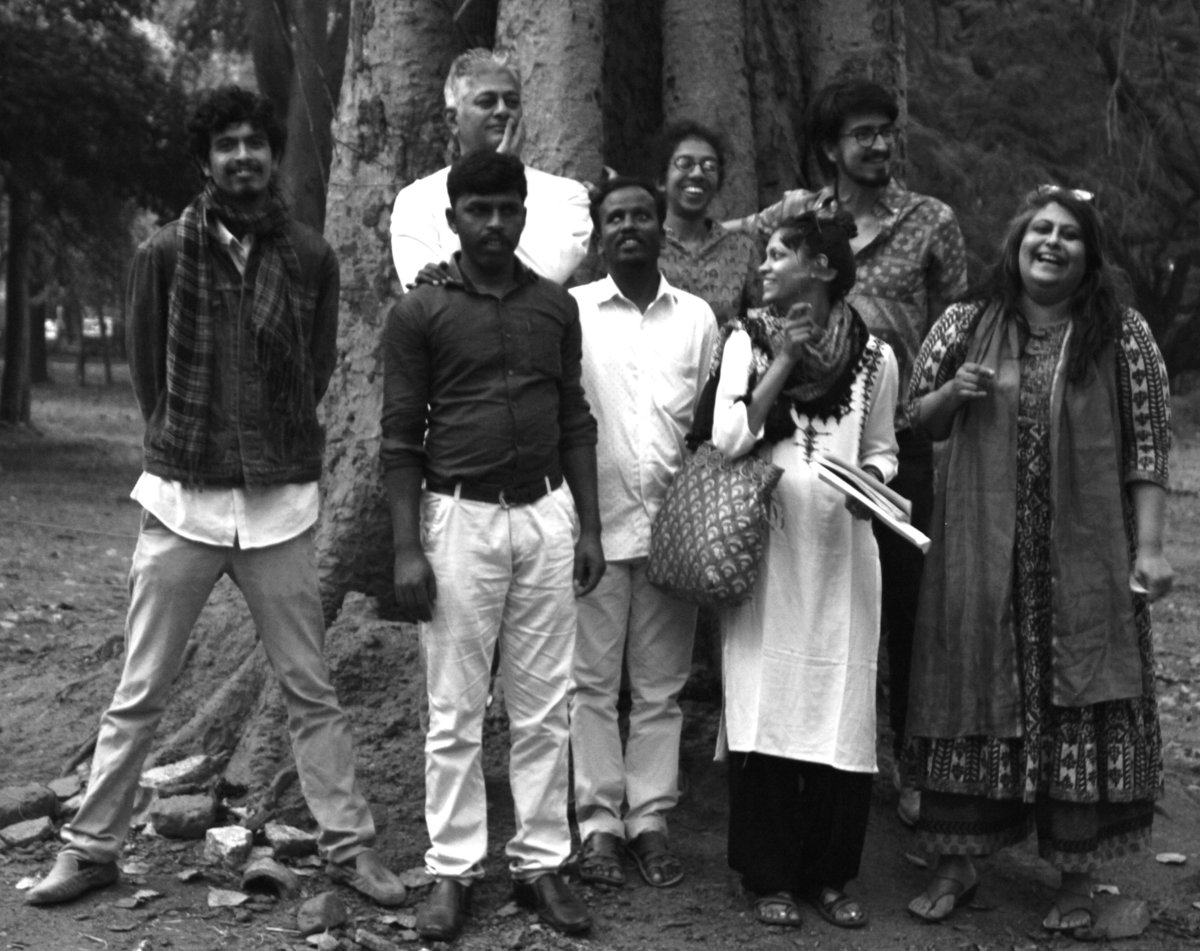
Carlos Andres Rico, Maraa and Goethe-Institut Bangalore with Madhuri & Jagadeesh of MoonArra.
The month long project involved rehearsals, and a concert-installation style of performance in Cubbon Park on Dec 16 and Dec 21 at Goethe Institut Bangalore.
https://maraa.bandcamp.com/album/attention-this-is-not-censored
Preview of some of our music is available on SoundCloud:
 https://soundcloud.com/moonarra-world-fusion/
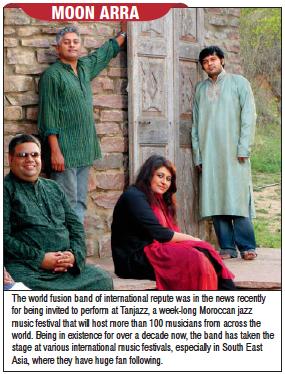
Indian Accent reviewed in Bangalore Times Jan 7 2011
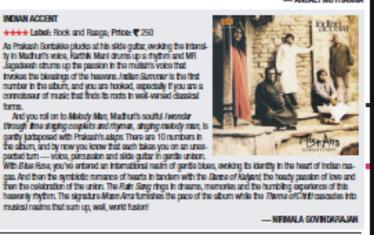
A review of MoonArra's concert which appeared in The HIndu, Chennai in June 2010:
A June rain showered the trees lining Le Royal Meridien. Below the graciously curving staircase, at the Grand Madras Ballroom, MoonArra, the world fusion band readied to take centre-stage as the opening act in Alliance Française's Fete de la Musique. MoonArra, meaning three streams, draws its inspiration from “sounds that have travelled from North India to Andalusian Spain to their collective upbringing in Carnatic and Hindustani classical.” The music by Madhuri (vocals), Jagadeesh (acoustic guitar, oud) Prakash Sontakke (Hindustani slide guitar, Indian classical vocals), Karthik Mani (South Indian percussion, drums and konnakol) and Wilson Kenneth (bass) was alchemical, a pause between wakefulness and dreams.
Their first two pieces — an invocation to Ganesha and ‘Lament of McCrimmon', an 18th Century dirge were turbulent, much like the meeting place of the three streams that is their leitmotif. But the band honed their sound as their evening wore on, and when they peaked nine pieces later, it was truly a calm ‘sangam' of cultures. However, only a few from the audience waited long enough to witness this.
Madhuri's strong contralto is quiet, dark and deep as if emerging from a haze with tender, forlorn lyrics that spoke of women, familiar stances of childhood, and love and longing. She sang nothing bombastic and glitzy, which is the voice of much of jazz; instead, she sang melodies without profound displays of vocal agility. ‘If I could sing your blues', a Sarah K original, was performed with plenty of world elements, ‘Blue Fuse' had a wonderful display of scat, while ‘Melody Man', an original composition and ‘Don't conceal the way you feel' were like a crackling fire in the hearth.
Jagadeesh, who first strummed the oud and later the guitar in slow, meditative minor keys played notes, that mused about lost love and uncertain journeys. Prakash, Wilson and Jagadeesh were proficient without being showy, and even the elaborate pieces such as the beautiful instrumental ‘Eastern Song', the award-winning ‘Heart's Guide', and the melodious ‘Dance of Kalyani' with a Hindustani interlude by Prakash, were modest with military precision, impulsive zaps and solemn strings.
MoonArra's lush, soulful world music did not underline much innovation, but had a rich texture in which voice and instrument breathed together to create a harmony that gave the audience an air of being caught up in a musical spell. The notes emerged and faded determined only by the mood of the moment. The band, although influenced by Afro-Cuban rhythms, Arabic strains and Spanish ballads, dissolved them all into one sound with conventional notions of authenticity. Every influence was in its place and the many rudiments were not encouraged to go anywhere they ought not to have been. And, anchoring this tradition was the percussionist, Karthik Mani. With the drums, the kanjira and the konnakol, he secured the band's music with powerful beats and dramatic double time.
MoonArra's music was as chatty as the band, honest without hype and distilled over the evening. It was a bridge to music from across the world with a geography all its own.
It was a pity that most of the audience never ventured to cross it.
DEEPA ALEXANDER
Indian Accent; MoonArra - Reviewed in The Hindu Jan 12 2011
Quintessentially fusion, MoonArra fulfils their claim of playing world music. The band has a sound that connects you to a whole new realm of music that cannot be labelled. It is impossible to classify them as Carnatic, Jazz, Pop or any other genre. With lyrics that are arbitrary and poetic, and music that is erudite and classical fusion, the band gives to the world their new album, “Indian Accent”. The band has been together since the early 2000's and “Indian Accent” is their first ever album. The line up of the band includes Madhuri Jagadeesh on vocals and Jagadeesh M.R along with Wilson Kenneth, Prakash Sontakke and Karthik Mani. The band collectively has a background in Hindustani and Carnatic music coupled with the harmony of jazz, a brush of folk and a tint of pop, you have ten songs that have been fused with brilliance. MoonArra's music draws from different cultures and influences and comes together to create a new and individualistic sound, independent of all else. The album opens with “Indian Summer”, a song that lyrically captures the essence of a simple India, an ethnically diverse India, and an archaic India that has been forgotten. “Children brown and happy as the sun, Can you smell the fragrant jasmine,” the song could be a jingle for an Incredible India advertisement. But with Madhuri's voice that changes texture on demand, the song is the highlight of “Indian Accent”. “Melody Man” has the most striking lyrics among all. With words like crimson and rhythm, and references to mango leaves and turmeric weaves, this song is poetry written and composed by Madhuri and Jagadeesh. “Blue Fuse” is another song that you continue humming, long after you have heard it several times on loop. Keeping with the title of the song, the arrangement has a very significant blues and jazz sound. “Eastern Sun” begins with some very intricate strumming, pleasing and you want it to continue without stopping, and it does for the rest of the track. The song expresses the sunrise over the Eastern hemisphere. The “Dance of Kalyani – Prelude” which has been composed by Madhuri and Jagadeesh is another instrumental which has a strong classical flavour. This is followed by “Dance Of Kalyani” which takes the pure prelude and adulterates it with some smooth jazz and intermittent drumming. The album concludes with “Theme For Chitti - Prelude” and “Theme For Chitti”. The instrumental pieces are a tribute to Chittibabu, a veena player from Karnataka who experimented with fusion in the later 70s.
CATHERINE RHEA ROY